Where We Are: Nearing or in Year-Over-Year Decline
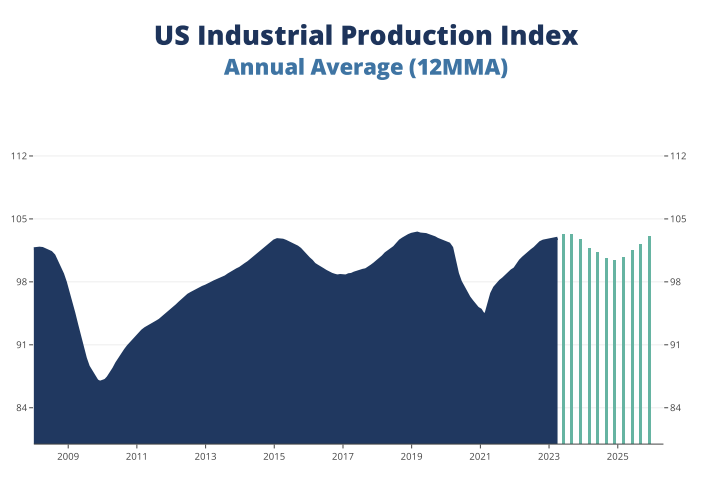
Downward pressures are intensifying across a wide breadth of markets, and we are seeing more growth rates drop to near or below zero. The single-family residential construction market has been bludgeoned by elevated interest rates, with annual US Single-Unit Housing Starts down 22.2% from one year prior. Adjusted for inflation, annual US Total Retail Sales are virtually flat. The industrial sector is still rising, but the growth is being driven by the oil and gas sector; the manufacturing and utilities segments are declining. Nonresidential construction, which lags behind other sectors of the economy, is accelerating, but elevated interest rates, tightening credit standards, and a weakening economy will likely discourage new projects.
As demand softens, an accompanying shift in prices is occurring. US Consumer Prices inflation has declined from a peak of +9.1% in June 2022 to +4.0% in May, but the Federal Reserve is maintaining a hawkish tone. Meanwhile, the more volatile US Producer Prices inflation has moved from +18.3% to -0.9% over that same time. The factors that drive prices have flipped: With elevated interest rates raising the cost of borrowing, there is no more “free” or “cheap” money. Seized-up supply chains have loosened. Consumers’ ravenous appetite for goods – particularly discretionary or financed items – has tempered as inflation has cut into their purchasing power. Prices typically have some degree of “stickiness,” meaning we are unlikely to see prices revert to pre-pandemic levels on the whole, but some decline is likely. Wages, meanwhile, are a cost that is likely to continue to rise given the demographically driven shortage of labor. Producers with relatively limited pricing power should be prepared for margin compression. If possible, set yourself apart from your competition by leveraging your competitive advantages. Look for efficiency gains to bolster your margins. It will be beneficial to keep more cash on hand, both to shore up your financial position and position yourself to take advantage of deals at the bottom of the cycle, which will occur around late 2024 for most markets.
Evidence for What Lies Ahead
The US Treasury yield curve remains inverted, a status that typically precedes macroeconomic weakness. Additionally, the inflation-adjusted M2 Money Supply is declining, banks are tightening their lending standards, and interest rates remain elevated. These trends indicate fewer real dollars to support spending. Consumer financial metrics are worsening, though nowhere near as shaky as in the months preceding the Great Recession. Savings balances have not kept up with inflation, and savings rates are well below normal. Credit delinquency rates, while low relative to historical trends, are rising. These signals suggest that economic challenges are mounting, supporting our outlook for a recession during 2024. Our forecasts include the assumption that the Federal Reserve will shift toward more dovish monetary policy as this year progresses. If the Fed continues to pursue hawkish policy, the anticipated recession could be longer-lasting or more severe than forecasted.
Tentative Green Shoots
Housing affordability constraints have eased slightly in recent months due to lower new home prices, slightly lower interest rates, and rising real earnings. While affordability metrics are still a long way off from historical norms, the slight improvement bodes well for upcoming recovery in residential construction, which typically leads the macroeconomy. We will be watching for US Single-Unit Housing Starts to show signs of recovery later this year. However, interest rates, which are subject to Federal Reserve policy, are a significant factor, and the Fed has thus far prioritized combatting inflation at the risk of depressing economic activity. The ITR Leading Indicator™ has ticked up and could signal an earlier economic low than the late-2024 timing we are calling for. However, we are skeptical about the viability of this upside movement due to the combination of downside pressures we have outlined above. Consequently, we are in a wait-and-see position on this nascent leading indicator implication at this time. Other indicators, such as the ITR Equity Optimizer Leading Indicator™, ITR Retail Sales Leading Indicator™, and US Total Industry Capacity Utilization rate-of-change, are still declining.