Current Events
Uncertainty and risks to the financial system have dominated the headlines of late. The recent bank failures have sparked fears of instability, exacerbated by painful memories of the Great Recession. The sharp increase in bond yields in the last year means that bonds bought during the pandemic now command a lower price in the secondary market. This is not a problem when such bonds are held to maturity or where hedging has been employed to address this risk. However, bank runs forced some banks to sell these securities early and cement a real loss. The bank failures to this point have come down to a combination of failing to hedge against this interest rate exposure and an abnormal level of exposure to specific sectors, such as tech. The FDIC has increased its coverage beyond the usual $250,000-per-depositer limit, and the Federal Reserve has created a new liquidity facility; this seems to have quelled fears. We continue to monitor the situation but are not immediately worried about a systemic failure.
The Federal Reserve has raised the federal funds rate twice so far in 2023. Our current forecasts would accommodate an additional 25–75 basis points of rise. Current Federal Reserve signals are toward the lower end of that range, though the body’s actions often deviate from its own projections. Should the Fed raise rates by more than we are currently expecting or keep rates high for longer (we expect cuts by the end of this year), it would pose a downside risk to many of our outlooks and likely lead to a more severe or longer-lasting recession for the US economy than currently forecasted.
Clues on the decline ahead
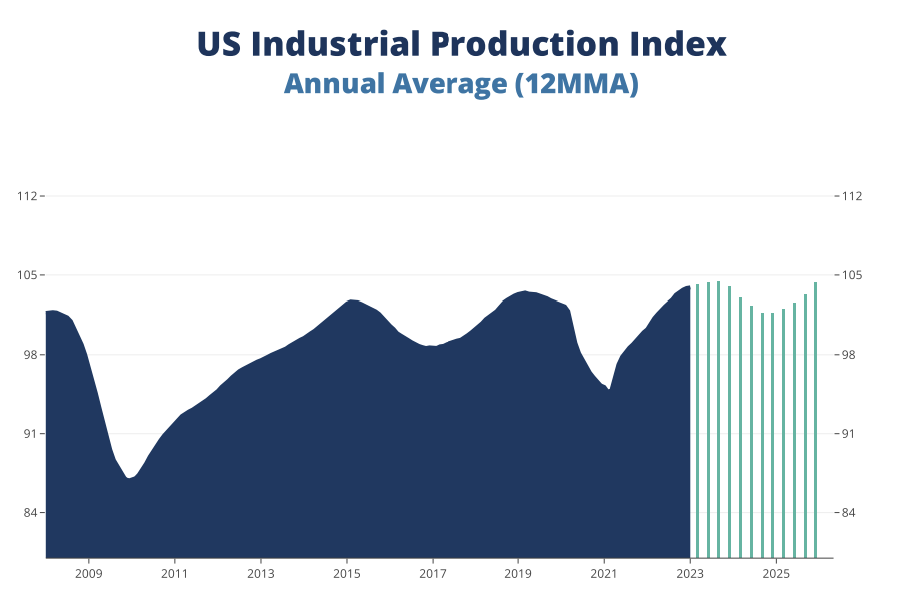
We are forecasting worsening economic conditions as this year progresses and recession in 2024. Residential construction will likely reach a low sooner, in mid-2023, and nonresidential construction will have a later low in 2025. Cyclical downturns come with a lot of uncertainty and attendant anxiety. Knowing when the trough will occur can help assuage those worries. Our system of leading indicators, proven through decades of business cycles, provides directional guidance for the next two to four quarters. While we have seen some burgeoning upward movement in a handful of indicators, it has not been enough to confirm a shift in momentum. Sustained rise in leading indicators starting late this year would confirm our forecasted late-2024 macroeconomic low.
We expect the upcoming recession to be relatively mild. Multiple factors will contribute to this mildness. First, consumer balance sheets remain solid, with relatively low debt-to-income ratios, muted credit delinquency rates, and rising inflation-adjusted income. Second, the trend of onshoring and nearshoring manufacturing facilities to strengthen supply chains is likely to persist, providing new opportunities for domestic manufacturers. Third, many manufacturers built up robust backlogs during the period of supply chain disruption that characterized the pandemic. Provided we do not see large-scale cancelations, these backlogs will act to smooth out activity, contributing to a milder declining trend.
Takeaways for your business
As is the case with many recessions, it will be essential in the coming quarters to know your customers and your market. Given inflationary pressures, we expect this contractionary period will take a heavier toll on lowerincome consumers. It will be essential to determine your customer base’s willingness to stick with your products over lower-cost alternatives. Promote your business’s competitive advantages; ensure your customers know why they do business with you over your competitors. Secondly, re-examine any planned capital expenditures – do they address persistent issues, or are you adding capacity that you will not need for another few years? Given the recent bank failures, as well as higher interest rates, credit conditions are likely to be tight. Be on good terms with your banker and make sure you have sufficient cash on hand. Finally, do not fall into the rabbit hole. In the long term, we expect the US to be well-positioned as a place for business.