Divergent Outcomes Are Likely in 2024
Consumers are the bedrock of the US economy, and mid-to-upper-income demographics are proving resilient. Consumers are buying a record dollar-value and volume of goods and services, funded through rising income, lower savings, and – in some cases – more debt. Record buying is occurring despite material economic headwinds. Consumer prices are up roughly 20% over the last four years and borrowing costs have soared from record lows to multi-decade highs. These pressures have been felt more acutely by lower-income consumers.
Meanwhile, many mid-to-upper-income consumers are benefiting from relatively high home values and growing cash balances. Our analysis indicates that spending by higher-income consumers is having a larger impact on the economic data relative to spending by lower-income consumers. Relatively strong mid-to-upper-income consumers are driving growth in housing construction, as they are more likely to be able to buy despite still-elevated mortgage rates. Rise in US Single-Unit Housing Starts is likely to persist in the coming years given the tight stock of existing homes and expected improvement in financial conditions in the coming years. There are also regional differences at play here due in part to domestic migration trends; much of this recent growth is in the South and West regions of the US.
We expect slowing growth for US Real GDP in 2024, with the potential for one quarter of mild decline. Retail spending is likely to plateau, while the services sector will slow in growth. Sizable government spending is an upside for the economy and is benefitting not only the public sector, but it is also having knock-on positive effects in the private sector, noticeable in the nonresidential construction and services sectors.
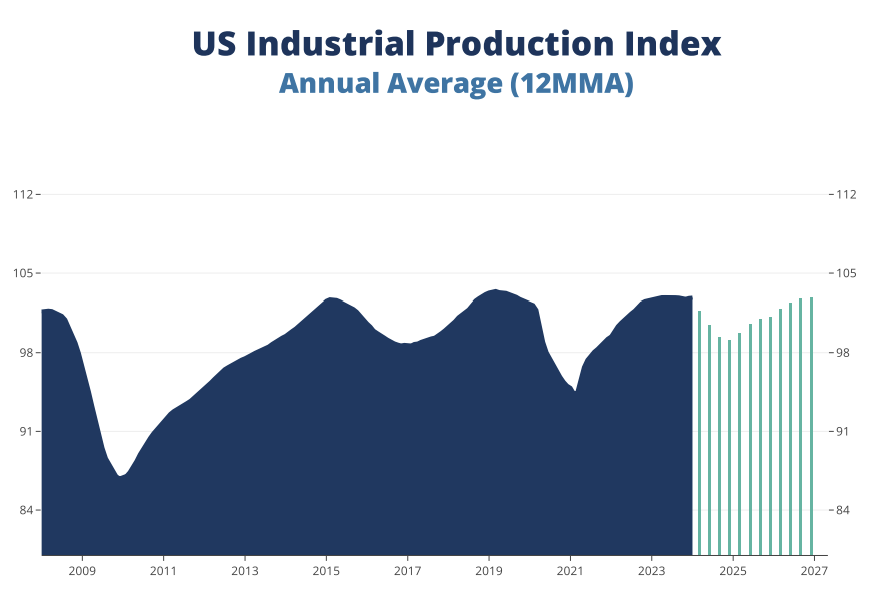
Businesses are showing hesitance towards capex amid the slowing macroeconomy, high borrowing costs, and tight credit conditions. Total Manufacturing New Orders have plateaued and existing manufacturing capacity is being utilized at a lower rate. Contraction is likely for many industrial markets in 2024, if it has not already materialized. Businesses, including those in the manufacturing sector, are holding larger amounts of cash than is typical this cycle, which may offset some of the downside impact of monetary policy. This is part of the reason we expect this downturn to be mild. The resilient consumer and near-sourcing will also contribute to the downturn being mild.
Growth Will Follow in 2025 and 2026; What to Know for Planning
Know your markets and where your products place relative to your competition. If your business caters directly to consumers, consider your end users’ demographics, as your sales performance may differ depending on customers’ income levels or on regional trends. Consider how price and interest-rate-sensitive your clients are, as it will likely be hard to lift prices this year, and rates will likely move lower but remain relatively high. Companies with exposure to the services sector or public spending are more likely to experience a soft landing relative to the industrial sector. Look for opportunities tied to reshoring.
If possible, try to keep an extra cash buffer this year to help you mitigate the current high interest rates and to provide both security and flexibility. This year will also be a good time to try to improve efficiencies and cut back on discretionary spending to help offset the impacts of wage pressures.
Evidence for the next rising trend is already forming. Recovery in US Single-Unit Housing Starts, which lead the US economy, suggests rise will begin in 2025. Additionally, the FOMC is messaging potential rate cuts this year. Discernable impacts to the economy typically lag changes in rates, meaning much of the impact of these potential cuts would be seen in 2025. Even if your market is poised for a downturn this year, make sure to look beyond and focus on how your business can be best positioned for the rise coming in 2025 and 2026.