A Mid-2025 Economic Update
Despite a wave of pessimistic sentiment reflected in some soft data sources (e.g., consumer confidence surveys), the US economy has demonstrated underlying resilience, as evidenced by hard data metrics. Although US Real GDP contracted minimally in Q1 2025, this was driven primarily by a surge in imports as businesses and consumers sought to preempt future tariff actions — a dynamic that mechanically subtracts from GDP. Both the consumer spending and business investment components of GDP registered growth in Q1, underscoring resilience in the underlying demand base. This is corroborated by monthly data through May showing accelerating industrial activity and rising Retail Sales. The policy environment remains uncertain, with trade negotiations oscillating between cooperation and friction. Elevated levels of macroeconomic uncertainty remain, prompting caution among decision-makers and tempering the pace of the current cyclical expansion.
Nonetheless, our proprietary composite of leading indicators points to a mild upward trajectory for the US economy over the remainder of 2025. That said, recent trends have prompted slight downgrades to several of our key sector-specific outlooks. We have modestly lowered our outlook for US Nondefense Capital Goods New Orders (excluding aircraft), a proxy for business-to-business (B2B) spending and capital investment. A historical data revision from the source revealed that the B2B sector is recovering from a prior mild recession that likely resulted from a prior period of excessive inventory buildup. The aggregate signal from our system of leading indicators suggests a general, but mild, rise is still more likely for B2B spending in 2025 than contraction. Growth will likely be slightly stronger in 2026. It is important to note that some of this growth, expressed in nominal terms, will be supported by inflationary pricing dynamics rather than volume gains, which could put pressure on margins in price-sensitive sectors.
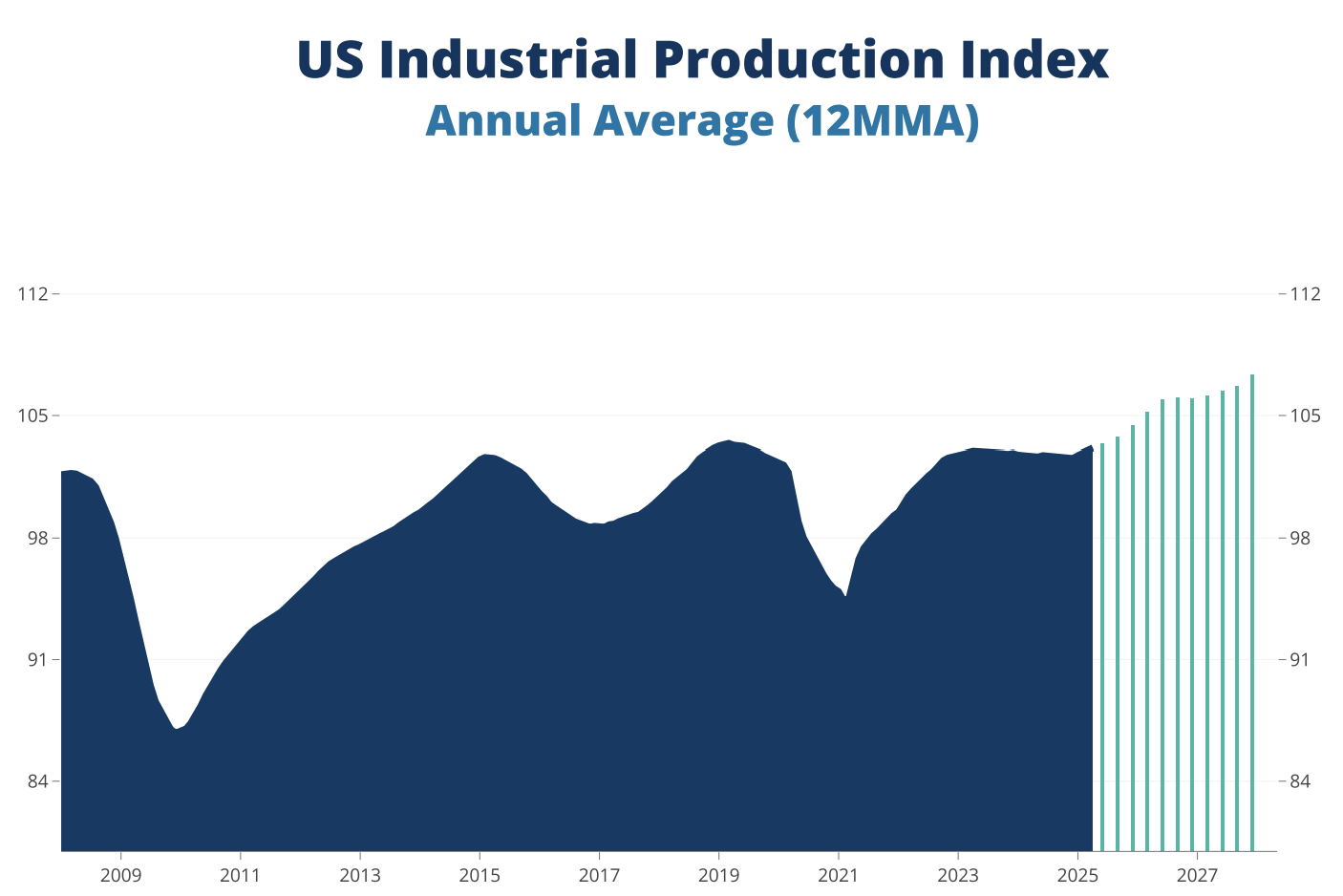
U.S. consumer Prices have been trending above the Federal Reserve’s inflation target of 2.0%, and economic activity has been holding up relatively well. As a result, the Fed has been holding interest rates steady, with no committed timeline for future cuts. Elevated interest rates will generally contribute to the muted nature of the rise ahead, although markets will ultimately adjust to this “new normal.”
Housing and Consumer Markets
Our forecast for US Single-Unit Housing Starts, which tends to lead the macroeconomy, has also been revised downward. Despite the persistent shortage of existing housing stock, developers may be slightly more risk-averse in light of a slight uptick in vacancy rates, persistent affordability concerns, and ongoing economic uncertainty. As a result, we expect Starts for 2025 as a whole to come in below the 2024 total before growth returns in 2026 and, to a lesser extent, 2027. Sectors tied closely to residential construction should prepare for near-term softness.
Consumer spending is expected to grow at a moderate pace over the coming years. The lingering impact of cumulative inflation appears to be fostering a more discerning consumer mindset. Businesses with more exposure to discretionary segments, especially those catering to lower-income consumers, could underperform relative to the rest of the market. Our proprietary ITR Retail Sales Leading Indicator™ signals that, on the whole, Retail Sales will gradually gain momentum into at least early 2026, although vacillation in the indicator suggests the rise could be slightly choppy. Overall, we anticipate US Total Retail Sales growth through 2027, with 2026 marking the likely high point in terms of annual growth rates.
Businesses should take a proactive stance on margin management, as current macroeconomic conditions suggest an elevated risk of margin compression. Rising input costs, cautious end-market demand, and muted volume gains all underscore the importance of cost discipline, pricing strategy, and capital efficiency.