The following content is sponsored by KYKLO.
Our customers are talking about artificial intelligence in procurement. The assumption is straightforward: if they apply AI to purchasing, the system will become smarter, faster, and more efficient.
But there is a problem. Artificial intelligence cannot evaluate products that do not exist in structured digital form. And today, much of the industrial product world is still organized for human readers rather than machines.
Until recently, that limitation was manageable because purchasing decisions were made by people who could interpret incomplete product information. But Something much larger is beginning to develop inside the procurement departments of many industrial companies. Artificial intelligence is starting to change how routine purchasing decisions are made.
Procurement systems are becoming more sophisticated. Instead of simply recording orders after a buyer places them, these systems are beginning to monitor inventory levels, track consumption rates, compare supplier pricing, and generate purchase recommendations automatically. In some environments, the system can even place replenishment orders without human intervention. To understand the scale of this shift, Gartner forecast at its recent IT Symposium that AI agents could intermediate more than $15 trillion in B2B spending by 2028.
In other words, machines (not people) are starting to shop and eventually buy from distributors in our industry, particularly for routine replenishment purchases. That shift has an important implication for manufacturers and distributors.
For an AI procurement system to work effectively, it must interact with suppliers whose systems provide structured digital information. The system needs access to product specifications, pricing, availability, and ordering capability in a format that software can interpret.
Unfortunately, the industrial product data environment is far less organized than many people realize. Research from KYKLO and the Distribution Strategy Group found that 90% of manufacturers have less than half of their published U.S. price list searchable on their website.
AI procurement cannot evaluate what does not exist in a structured digital form.
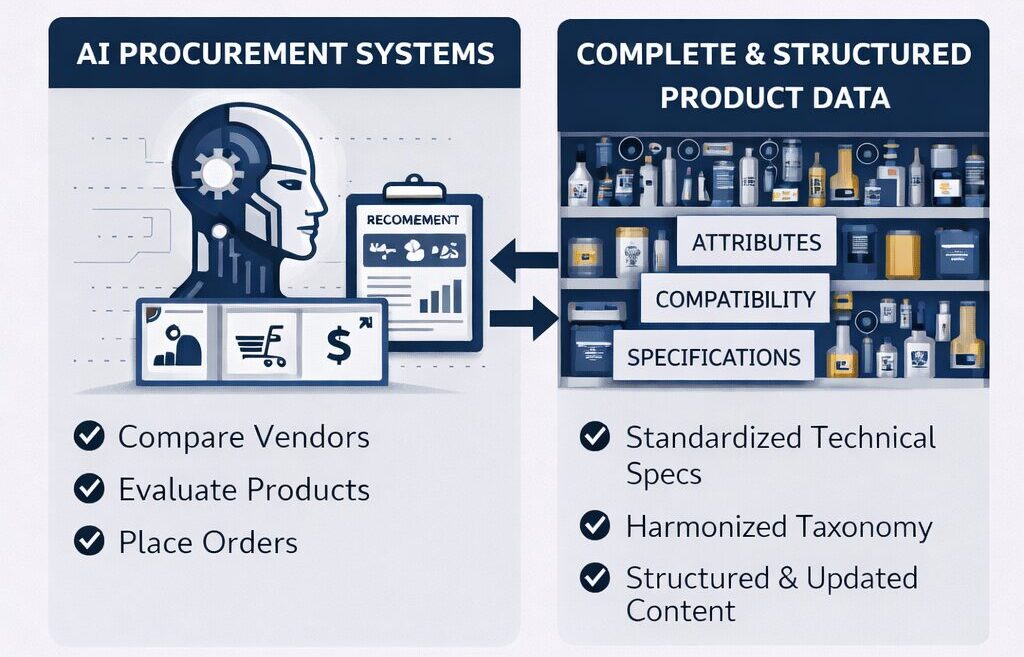 Most manufacturer product data still exists in formats designed for humans rather than machines. Specifications are often buried inside PDFs. Technical attributes are incomplete or inconsistent. Product taxonomy varies widely between brands. Units of measure are often not standardized. Compatibility information is frequently missing.
From the perspective of an automated procurement system, this creates a serious problem. Software cannot reliably compare or select products when the underlying data is inconsistent or incomplete. This is where distributors often play a much larger role than manufacturers realize.
Over time many industrial distributors have quietly built the infrastructure required to make product data usable in digital commerce. Behind their e-commerce platforms sits an extensive layer of data normalization and enrichment. This includes structured technical attributes, harmonized product taxonomy, completed manufacturer data, consistent units of measure, and cross-brand normalization that allows comparable products to be evaluated accurately.
Distributors integrate this information into their enterprise systems so that pricing, availability, and ordering can be executed automatically. In practical terms, distributors frequently provide the digital infrastructure that allows industrial product information to function inside modern commerce systems.
That infrastructure becomes even more important as AI procurement expands.
Artificial intelligence can create a dangerous sense of confidence.
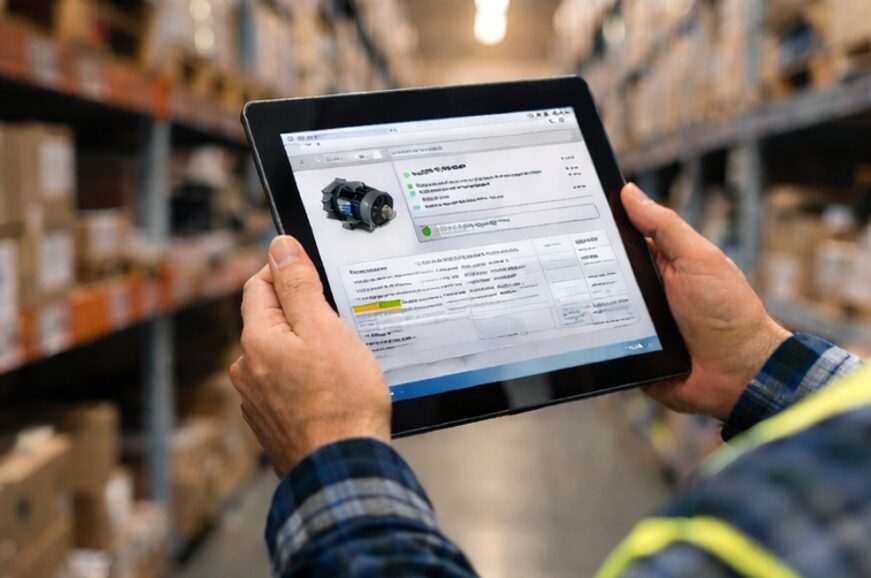 AI systems are extremely capable of analyzing information, but they are only as reliable as the data they receive.
If the underlying product data is incomplete, inconsistent, or outdated, the AI system may recommend the wrong product, misinterpret specifications, or substitute an incorrect equivalent.
The consequences in an industrial environment can be serious. Incorrect product selection can lead to downtime, safety risks, compliance problems, costly returns, and damaged
trust between supplier and customer. For that reason, the data foundation supporting AI procurement will prove to be equally important as the AI itself.
This is where advanced industrial product data platforms play a significant role. Solutions such as KYKLO provide millions of enriched SKUs with structured industrial attributes, harmonized taxonomy, and continuously maintained product information designed specifically for digital commerce environments – ensuring product data is not only complete, but ready to be deployed across ERP, e-commerce and other systems.
This type of structured content can be deployed directly into distributor ERP systems and syndicated across e-commerce platforms, creating a consistent digital framework that allows procurement systems (and increasingly prevalent AI systems) to evaluate products accurately. Further, manufacturers who want their products to remain easy to buy in the future will increasingly depend on distributors who provide this level of digital capability.
In the recent past, manufacturers evaluated distributors primarily on territory coverage, inventory investment, and sales performance. Those factors remain important.
But digital infrastructure is quickly becoming a key form of channel capability.
Distributors who invest in structured product data, strong e-commerce platforms, and normalized product information are building something extremely valuable. They are creating a digital bridge that allows manufacturers’ products to participate in automated purchasing environments.
For manufacturers thinking about the future of their channel strategy, the question may soon shift. Instead of asking “which distributors sell our products well?”, they now need to ask: Which distributors have the digital infrastructure to ensure our products can be purchased by the next generation of procurement systems?
Because in an AI-driven purchasing environment, the suppliers that are easiest for machines to evaluate and buy from may increasingly be the suppliers that customers buy from most often.
In the very near future, the most important salesperson a manufacturer has may not be a person at all. It may be the quality, completeness, and structure of the product data behind the distributor’s e-commerce platform.