The following content is sponsored by Precision.
In today’s competitive industrial landscape, category management is more than a buzzword, it’s a strategic imperative. But many channel leaders still rely on gut feel, standard ABC curves, or legacy ERP reorder logic. The result: missed opportunities, stockouts, and fragile supplier relationships.
Below, we draw from new thinking shared in a three-part series by Industrial Supply Trend’s John Gunderson to show how manufacturers and distributors can partner to upgrade their game.
1. Establish a Data Foundation
The core of strong category management is customer buying behavior + transaction data. Without that, you may misclassify SKUs even when for a key customer they’re mission critical. Leading organizations build systems that overlay customer segmentation and purchase patterns to drive smarter inventory, pricing, and allocation decisions.
2. Build Processes That Move Fast
The number of SKUs in today’s portfolios demands speed and efficiency. Top teams craft processes so their analysts and category leads can manage more SKUs more efficiently, without drowning in spreadsheets. At every level – national, regional, branch – you need scorecards and dashboards tailored to that audience.
3. Elevate the Conversation Between Partners
Perhaps the biggest opportunity lies in how manufacturers and distributors work together. Too many report cards are full of metrics that look impressive but don’t move the needle.
Better practice:
- Audit your current reports and strip them down to the top 2–5 metrics that directly impact fill rates, inventory turns, or growth
- Make the rest of the metrics “appendix” items.
- Continually optimize: test, discard what doesn’t resonate, and refine over time
Key Takeaways for ISA Channel Leaders
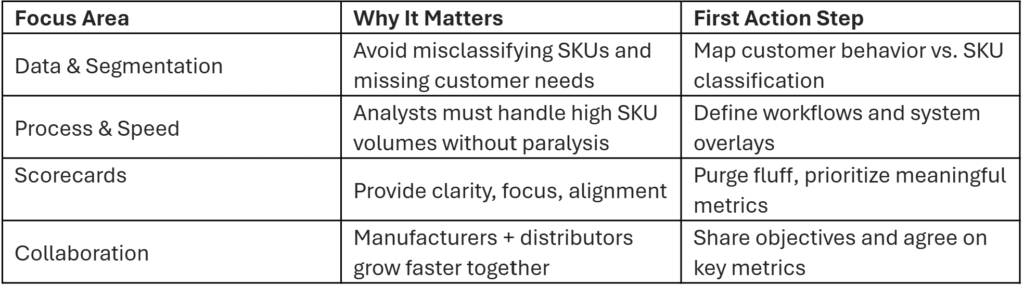
The industrial channel cannot afford to settle for “good enough.” Category management done well is not a cost center, it’s a growth engine. By grounding decisions in data, building scalable processes, and holding one another accountable through meaningful scorecards, manufacturers and distributors can shift from transactional partners to strategic allies.
If you’d like to explore how to apply these practices in your organization, or see examples of scorecards in action, reach out to Precision today.