Complete the form below to download the full report.
What to know for 2027 planning: the economy is likely to slow, but there will be opportunities for growth. The businesses best positioned for next year will recognize this shift early. Do not plan for a repeat of 2026.
A major risk for many companies is mistaking higher revenue for stronger underlying activity. Pricing will still support top-line results in parts of the economy, but unit volumes will be weaker in the coming year. This softer volume outlook matters for hiring, inventory, capacity, and capital allocation. If you trend alongside the macroeconomy, be more conservative in your planning for 2027.
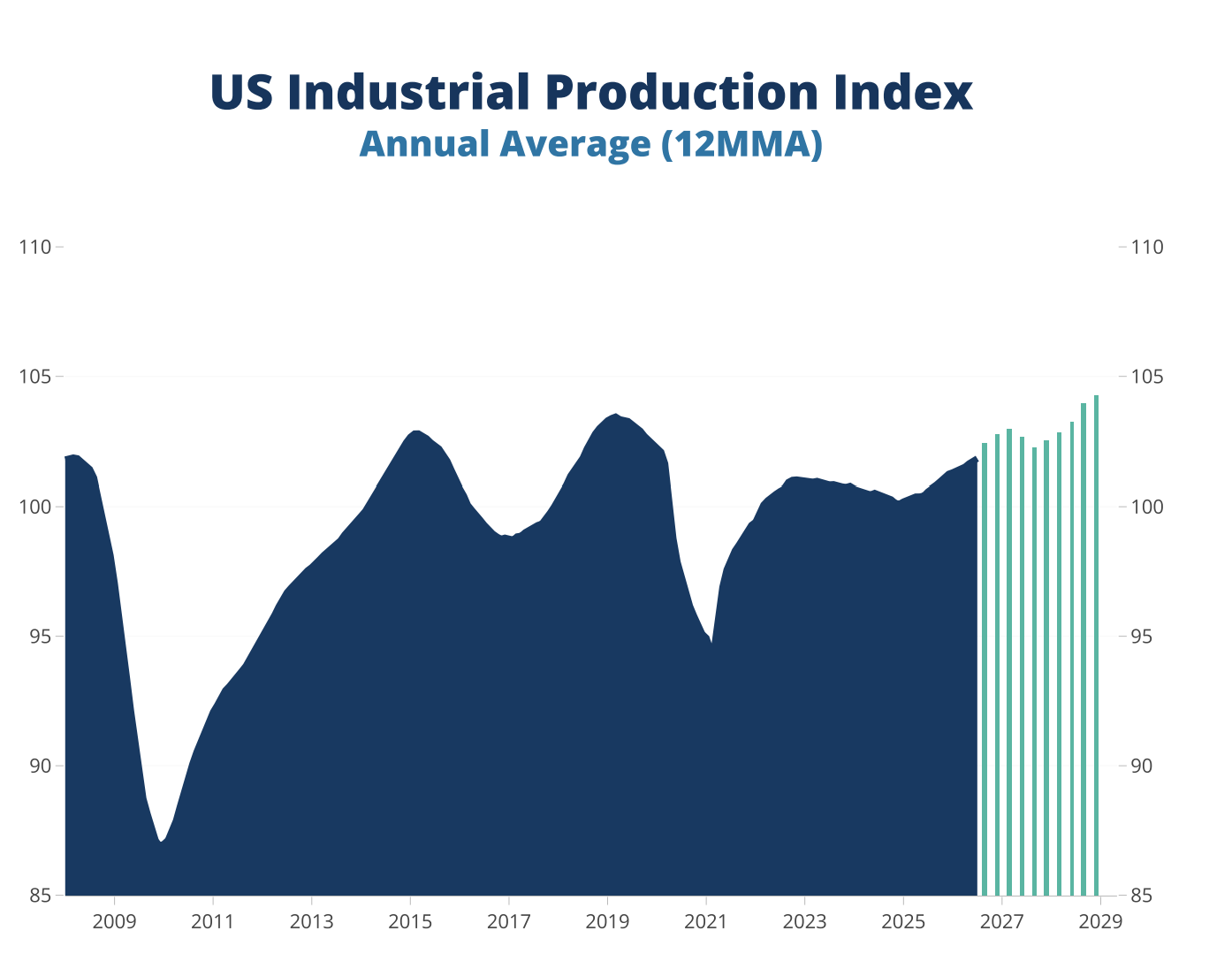
Business investment will rise in the first half of the year and decline later in the year, but performance will vary by market. Demand tied to high technology and supporting infrastructure, automation, power generation, and defense will outperform broader business investment. Invest where the payoff is clear but avoid extrapolating recent growth too far into next year.
Consumer markets will likewise be softer in 2027. Stable employment will continue to support higher spending, but cumulative inflation has weakened purchasing power and made saving more difficult. That combination leaves consumers more cautious, especially for discretionary and big-ticket purchases. Elevated borrowing costs are likely to remain, keeping mortgage rates, auto financing, and credit card rates uncomfortable, limiting households’ ability or willingness to stretch. Businesses serving consumers should expect price sensitivity to remain prevalent and remain ready to explain value, adjust product mix, or target customer segments with stronger financial resilience.
Construction will also be uneven. Single-unit housing is likely to stabilize but not meaningfully improve, with affordability still the central constraint. Elevated home prices, construction costs, mortgage rates, and uncertainty all point to a shallow recovery rather than a sharp rebound. Multi-unit housing is losing momentum as supply conditions and rent trends become less supportive. Nonresidential construction should be more favorable in 2027, boosted by earlier improvement in business activity and gradual recovery in commercial property prices, but that upturn will be restrained by high financing and building costs. The best opportunities remain concentrated in data centers, infrastructure tied to electrification and computing demand, and the pockets where prior government funding is still being spent.
Prices will generally remain elevated in 2027, although we are likely to see the pace of rise slow down. There will likely be pricing relief in small pockets, such as some metals commodities which have seen recent surges. For businesses, margin protection should be a central 2027 planning theme. Don’t count on being able to pass along costs; rather, invest in long-run efficiency improvements.
A slower year can still be a productive one. 2027 plans will need to balance preserving cash where risk is elevated and making selective investments that improve productivity. Staffing plans should be measured, but not so cautious that the business is unprepared for the next macroeconomic upswing coming in 2028. Process improvements, cross-training, and targeted marketing and sales efforts can all create advantages before growth improves again. Do not wait out the year. Use this lull well, protect profitability, and enter the next expansion with a stronger operating model.
Complete the form below to download the full report.
To view this content please fill out the form below:
"*" indicates required fields